 Enneagram Café
The Mediator
Type Nine
Nines tend to see the world as a place where harmony matters most. They often find themselves tuning in to what others need, creating comfort and connection – sometimes at the cost of losing track of their own priorities and preferences.
 If I’m left on my own, often I feel lonely and depressed. There’s a ‘juice’ in being with other people and I’ll seek that out.
It’s the classic scenario: I’ll be going upstairs to fetch my diary, then the plants call me and I go to water them, but the sink needs to be cleaned… An hour later it’s ‘What did I come up here for?’
It feels like driving with both feet down – one on the accelerator and one on the brake – it’s very frustrating.
It was very clearly ‘Don’t talk about what you’re feeling’ – or even seeing. Since it was not acknowledged, I just decided that I had no opinion.
What they need
To maintain peace, harmony, and a sense of belonging
What they avoid
Experiencing conflict, disconnection, or being overlooked
- A genuine ability to see all sides – inclusive, accepting, and non-judgmental
- A steady, calming presence that puts others at ease
- Patience and willingness to listen without rushing to fix
- Skilled at bringing people together and finding common ground
- A capacity for deep receptivity – open to others in a way that feels rare
- Difficulty knowing – or voicing – what they actually want
- A tendency to go along with others’ agendas rather than asserting their own
- Anger that gets suppressed and may surface as stubbornness or passive resistance
- Avoiding conflict even when something important is at stake
- A habit of numbing out or disengaging when things feel overwhelming
Recognise yourself? Our free exploration can help you find out whether this is your type – in your own words, at your own pace.
Begin the explorationThe inner world of a Nine
For Nines, there’s a deeply held sense that peace and connection are what matter most – and that maintaining harmony is worth whatever it costs. Other people’s needs, preferences, and agendas can feel more vivid and more pressing than their own. Over time, this creates a pattern of attending to everyone else while their own priorities quietly slip into the background.
This isn’t simply people-pleasing. Nines often genuinely experience other perspectives as compelling – they can see why everyone feels the way they do, which makes it harder to land on what they themselves think or want. There’s a kind of internal merging that happens, where the boundaries between their own feelings and everyone else’s become hard to distinguish.
The challenge is that peace maintained by setting yourself aside isn’t the whole picture. When a Nine’s own voice stays quiet for too long, it can lead to a slow accumulation of frustration – one that may not be recognised as such until it surfaces in unexpected ways. With awareness, Nines can learn to include themselves in the harmony they create for others.
The Nine pattern in everyday life
Many Nines describe a tendency to “go with the flow” – agreeing to plans, deferring on decisions, keeping things comfortable. This can make them wonderfully easy to be around: accepting, flexible, and genuinely interested in what others think. It can also mean that their own wants and opinions stay unexpressed, sometimes even to themselves.
At their best, Nines bring a rare inclusiveness to everything they’re part of. They notice who’s being left out, hold space for different viewpoints, and create an atmosphere where people feel heard. When the pattern runs them rather than the other way around, the same qualities can tip into indecision, avoidance, and a quiet withdrawal from things that matter to them.
The key insight for Nines is that the pattern itself isn’t the problem – it’s when it operates on autopilot. Noticing the impulse to merge or accommodate without automatically acting on it creates space for choice: to keep the peace when it genuinely serves, and to speak up when something important is at stake.
How Nines pay attention
For Nines, attention tends to flow outward – toward other people’s needs, preferences, and emotional states. Ask a group where they’d like to eat and the Nine may genuinely struggle to answer, not because they don’t have preferences, but because everyone else’s wishes feel louder and more immediate than their own.
In a meeting, a Nine might have a strong contribution but hold back, waiting to see where others land first. By the time they’ve checked that their idea won’t create friction, the moment may have passed. In conversations, their attention can track what the other person needs to hear rather than what they themselves want to say.
This pattern of attention makes Nines natural mediators and collaborators – they genuinely grasp multiple perspectives in a way that few other types can. But it can also mean that their own position gets lost in the process. Becoming aware of where attention goes is often the first step toward reclaiming it – noticing the habit of checking outward and learning to check inward as well.
Anger and agency
Nines are a Body Centre type, which means they tend to process the world through gut instinct and physical sensation. You might expect Body Centre types to have straightforward access to anger, but for Nines the relationship is more complex. When harmony matters this much, anger can feel like a threat to connection – something to smooth over rather than engage with.
So the anger tends to go underground. It may show up as stubbornness, passive resistance, a quiet digging-in – often without the Nine fully recognising it as anger. Many Nines describe themselves as “not really an angry person”, even while those around them can see the frustration building beneath the surface.
One of the most useful things a Nine can learn is that anger isn’t the enemy of connection – it’s information about what matters. With practice, that energy can become a source of clarity and motivation rather than something to be suppressed. Feeling angry doesn’t have to mean losing the peace; it can mean finding a more honest version of it.
Not sure if this is your type?
Our free typing exploration uses open-ended questions to help you find the types worth investigating. No algorithms, no scores.
Find your typeStress and growth
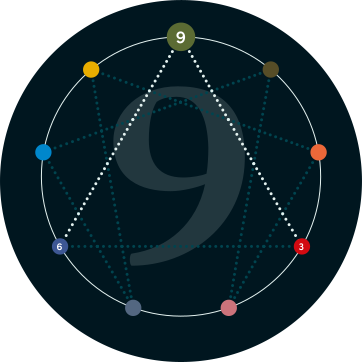
Under stress (moves toward Six): When overwhelmed, Nines can shift into the territory of Type Six – becoming anxious, worried, and prone to second-guessing. The usual calm gives way to doubt and a need for reassurance. They may cling to routines or become suspicious of others’ intentions in ways that feel unfamiliar.
In growth (moves toward Three): When Nines connect with their own energy and direction, they can access the focus and effectiveness of Type Three. They become more able to set priorities, take action on their own behalf, and follow through on what matters to them. Engagement replaces withdrawal.
The three subtypes
Self-preservation Nine: Appetite
The Nine pattern here focuses on physical comfort, routine, and familiar pleasures as a way of maintaining inner steadiness. There’s often a tendency to substitute small comforts – food, rest, familiar activities – for the harder work of engaging with their own priorities. This can be the most withdrawn expression of the Nine pattern, though the warmth and groundedness are still very much present.
“I used to watch TV whenever I wasn’t doing something else… I could find something “interesting” in anything, from the most frivolous to the driest subject.”
Social Nine: Participation
The Nine pattern here expresses through involvement in groups, communities, and shared activities. There’s often a strong sense of belonging through participation – but it can become a way of staying busy without confronting what they personally want. This subtype may be highly active and engaged while still avoiding the question of their own agenda.
“We are all one. It’s really important to me that everyone joins in and that the whole group works together, and that we enjoy ourselves doing it.”
One-to-one (Sexual) Nine: Fusion
The Nine pattern here focuses on close relationships, often merging deeply with a partner or significant other. There’s a tendency to take on the other person’s interests, priorities, and even identity as a way of maintaining connection. This subtype may be more visibly assertive about relationship needs while still finding it hard to voice disagreement directly.
“There is simply a big gap between me and the absolute love I long for. If I could only find that and sink myself into it completely, then everything would be all right; I would be whole.”
The path of integration
Integration for Nines doesn’t mean abandoning harmony – it means including themselves in it. With greater awareness, a Nine can notice the impulse to accommodate without automatically acting on it. They can hold their own position alongside others’ perspectives, and engage with conflict when something important is at stake, rather than defaulting to peace at any price.
TNE describes the spiritual dimension of the Nine as right action – the capacity to move forward with clarity about what genuinely matters, owning their own desires and priorities rather than deferring to everyone else’s. This isn’t selfishness; it’s a deeper kind of presence, grounded in knowing what they want and being willing to say so.
The invitation for Nines is to discover that they matter – that their preferences are worth voicing, that conflict can strengthen rather than sever connection, and that true peace includes their own presence rather than their absence from the picture.
Nines in relationship
Nines bring acceptance, patience, and a genuine warmth that makes others feel at ease. They tend to create a sense of stability and comfort, and their willingness to see their partner’s perspective can make them deeply supportive companions.
The challenge is that partners may struggle to know what the Nine actually wants – because the Nine may not be sure either. Decisions can default to the more assertive partner, with the Nine’s unspoken frustrations building quietly over time. What looks like easy agreement may sometimes be avoidance.
It helps to understand that a Nine’s accommodation isn’t always genuine agreement – and that asking directly what they prefer, then giving them space to find the answer, can make a real difference. Nines often need a little more time to locate their own position, and that patience is worth offering.
Understanding Nines
Whether you’re a Nine recognising yourself, or someone trying to understand a Nine in your life, these are worth keeping in mind:
- Help them keep focused by bringing their attention back, but gently – if pushed too hard, they will simply shut down
- Provide a supportive environment for them to experience and explore anger – it may be the emotion they find hardest to access
- Ask them what they want and need, what is important to them – and wait for a real answer, not the first accommodating one
- Help them differentiate between genuine agreement and going along to avoid conflict – tell them which feels like which to you
- Don’t mistake their steadiness for simplicity – Nines often have rich inner lives that they rarely share unprompted
This page is an introduction to the Nine pattern. The Enneagram is best understood through conversation and lived experience – hearing how others of the same type describe their inner world. Our courses and events explore all nine types this way, in small groups.
Go deeper with your type
These pages are a starting point. To really work with your type, it helps to hear from others and explore the patterns in conversation. That’s what our courses and events are for.
See what’s coming up