 Enneagram Café
The Enthusiast
Type Seven
Sevens tend to see the world as a place full of possibilities – exciting, expansive, and best experienced with options open. They find energy in what’s new and what could be, often moving toward pleasure and away from limitation.
 If I’m feeling a lot of heavy negative energy coming at me, the first place I go is inside to work out a way of getting out of this feeling, whatever it may be – change it, or show how the glass is actually half full, not half empty.
I don’t want to be seen as shallow. I don’t think I am. But… it’s not that I don’t feel deeply, but I don’t want to show it.
I’m not present most of the time – I’m off in the future, and it’s very pleasant there. Why should I come back?
Once you have forgiven me a few times, I start to believe that you really will be there for me – and maybe, eventually, start to touch the pain that I secretly know I’m always running away from.
What they need
To experience positive possibilities and keep options open
What they avoid
Feeling trapped, limited, or stuck in pain
- A genuine enthusiasm that lifts the energy around them
- Quick, creative thinking that connects ideas others miss
- Resilience and an ability to find possibility in difficult situations
- Warmth and generosity – they want others to share in the good stuff
- Adaptability and a willingness to try things that others hesitate over
- Difficulty staying with painful or uncomfortable feelings long enough to process them
- A tendency to reframe difficulty so quickly that important signals get missed
- Scattered energy – starting many things and finishing fewer
- Others can feel their pain is being minimised or rushed past
- Mistaking busyness and stimulation for genuine satisfaction
Recognise yourself? Our free exploration can help you find out whether this is your type – in your own words, at your own pace.
Begin the explorationThe inner world of a Seven
For Sevens, the world tends to feel like a place of abundant possibility – but also one that can limit, frustrate, and cause pain. The response, often developed early in life, is to move toward what’s pleasurable and interesting, and away from what feels confining or difficult. Over time, this creates a habit of generating options, plans, and exciting future scenarios – a kind of mental abundance that provides reassurance.
This isn’t simply about chasing fun. Underneath the enthusiasm, there’s often a quiet wariness of being stuck – in boredom, in pain, in a situation with no way out. The forward motion that others see as confidence or optimism can also be a way of staying one step ahead of something the Seven would rather not feel.
The tension for Sevens is that the richest experiences – depth, intimacy, real satisfaction – often require staying present with whatever arises, including difficulty. With awareness, Sevens can learn to notice the impulse to move on and choose whether to follow it, rather than being carried by it automatically.
The Seven pattern in everyday life
Sevens often bring a particular quality to any room they’re in – a lightness, a sense of possibility, a knack for finding the interesting angle on things. In conversation, their minds tend to move quickly, making connections and leaping between ideas in ways that can feel exciting or hard to follow, depending on the listener.
At their best, Sevens are genuinely uplifting. They see potential where others see obstacles, they bring energy to projects and gatherings, and they have a warmth that draws people in. When the pattern runs on autopilot, the same qualities can show up as restlessness, scattered attention, or a tendency to skim the surface of things rather than going deep.
Many Sevens describe a background sense of planning – a mental map of upcoming pleasures, possibilities, and options. This can be wonderfully creative and energising. It can also mean the present moment gets less attention than the imagined future. The practice, for Sevens, is often simply noticing where their mind has gone – and gently coming back.
How Sevens pay attention
For Sevens, attention tends to be pulled toward what’s pleasant, interesting, and full of possibility. Walk into a room with a Seven and they may well have noticed the most engaging person, the most promising conversation, the most exciting item on the agenda. This isn’t conscious cherry-picking – it’s an automatic pattern of attention, drawn toward what feels expansive and away from what feels limiting.
This shows up clearly in how Sevens process difficulty. When something painful happens, the mind often moves quickly to reframe it – finding the silver lining, imagining how it might lead to something better, generating alternative plans. This capacity for positive reframing is a genuine gift. It can also mean that painful feelings get processed very quickly, sometimes before they’ve been fully felt.
The blind spot tends to be limitation, pain, and the kind of depth that comes from staying with one thing rather than moving to the next. With practice, Sevens can learn to notice the moment attention wants to leap ahead – and choose to stay a little longer with what’s actually here.
Fear and certainty
Sevens are a Head Centre type, which means they tend to process the world through thinking, planning, and anticipation. You might not immediately associate Sevens with fear – they often appear confident, upbeat, and at ease. But underneath the forward motion, there’s typically a relationship with fear that drives much of the pattern: a fear of being trapped, limited, or forced to endure pain without escape.
Where Fives tend to withdraw into analysis and Sixes engage fear more directly, Sevens often manage it by moving toward pleasure and possibility. The mental planning – the constant generation of options and exciting futures – provides a kind of reassurance: as long as there are possibilities, nothing is truly closed off. The anxiety doesn’t disappear; it gets channelled into activity and optimism.
One of the most useful things a Seven can discover is that the fear of being stuck is often worse than the experience itself. Staying present with discomfort, even briefly, tends to reveal that it’s manageable – and that something more spacious opens up on the other side of it.
Not sure if this is your type?
Our free typing exploration uses open-ended questions to help you find the types worth investigating. No algorithms, no scores.
Find your typeStress and growth
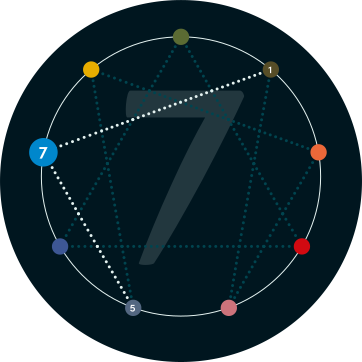
Under stress (moves toward One): When overwhelmed, Sevens can shift into the territory of Type One – becoming critical, rigid, and focused on what’s wrong. The usual flexibility and lightness may give way to frustration, judgement, and a surprising insistence that things be done a particular way.
In growth (moves toward Five): When Sevens allow themselves to slow down, they can access the depth and focus of Type Five. They become more comfortable with solitude, more willing to go deep into a single subject, and more able to find richness in staying with one thing rather than reaching for the next.
The three subtypes
Self-preservation Seven: Keepers of the castle
The Seven pattern here focuses on building a network of allies, opportunities, and resources to ensure practical needs are always covered. There’s often a pragmatic, grounded quality – this subtype can look less obviously “Seven-like” – but the underlying drive is still about keeping options open and ensuring there’s always enough.
“I’ve loads of friends, all over – some abroad – and each one of them is necessary to me.”
Social Seven: Sacrifice
The Seven pattern here channels desire through service and idealism. This is sometimes called the countertype because the outward expression can look quite different – more like a Two or even a One. The enthusiasm gets directed toward causes, communities, and helping others, though the Seven’s orientation toward what’s positive and pleasurable still shapes the underlying motivation.
“I don’t like it but I can put up with it. It will be wonderful, so if I have to do something right now that I don’t really want to, to ensure it, then I will.”
One-to-one (Sexual) Seven: Suggestibility
The Seven pattern here tends toward idealisation – seeing the world, and especially close relationships, through a slightly enchanted lens. There’s a dreamlike, imaginative quality: people and possibilities are painted in the most appealing colours. The challenge is that reality may struggle to live up to the imagined version.
“Of course I wanted to go scuba diving – right now! I knew nothing about it, but I wasn’t going to say so.”
The path of integration
Integration for Sevens doesn’t mean giving up their joy or enthusiasm – it means adding depth and presence alongside it. With greater awareness, a Seven can notice the impulse to move on without automatically following it. They can stay with what’s difficult long enough to learn from it, and discover that commitment doesn’t have to feel like a trap.
TNE describes the spiritual dimension of the Seven as steadiness – the capacity to bring focused attention to the present moment and to be with whatever arises without needing to introduce diversions or generate alternatives. This isn’t about restriction; it’s about discovering that the fullest experience of life is available right here, not in the next plan.
The invitation for Sevens is to discover that they can handle difficulty – that pain is temporary, that depth is more satisfying than breadth, and that the richest kind of happiness often comes from being fully present rather than reaching for what’s next.
Sevens in relationship
Sevens bring energy, warmth, and a genuine desire to create shared adventures. They tend to be engaging companions who can lighten heavy moments and see possibilities where others feel stuck.
The challenge is that partners may sometimes feel their difficulties are being reframed or moved past too quickly. When a Seven responds to someone’s pain with optimism or solutions, the intention is usually kind – but the effect can be that the other person doesn’t feel fully heard. Practising staying with a partner’s experience, without trying to fix or brighten it, can make a real difference.
It helps to understand that what looks like avoidance in a Seven is often a deeply ingrained way of managing discomfort. Inviting them to slow down – gently, without making it feel like a trap – tends to work better than insisting they sit with difficulty.
Understanding Sevens
Whether you’re a Seven recognising yourself, or someone trying to understand a Seven in your life, these are worth keeping in mind:
- Help them stay in the present by asking how they feel – not what they’re planning next
- Point out reframes and rationalisations in a non-critical way – Sevens often don’t notice they’re doing it
- When they are racing, gently name the possibility that they might be running from something – but don’t insist
- Make your own thoughts, feelings, and needs important in the relationship – Sevens can inadvertently fill all the space
- Create an environment in which it is safe for them to explore and express pain – it may be the thing they need most and seek least
This page is an introduction to the Seven pattern. The Enneagram is best understood through conversation and lived experience – hearing how others of the same type describe their inner world. Our courses and events explore all nine types this way, in small groups.
Go deeper with your type
These pages are a starting point. To really work with your type, it helps to hear from others and explore the patterns in conversation. That’s what our courses and events are for.
See what’s coming up