 Enneagram Café
The Questioner
Type Six
Sixes tend to see the world as a place where safety has to be earned rather than assumed. They find security through vigilance, preparation, and testing what can be trusted – building loyalty and reliability in the process.
 We’re not scaredy-cats – it’s not the kind of fear you read about in children’s books. I don’t see myself as fearful – but doubt and scanning, yes, I do that.
I don’t see it as courage – it just needs to be done.
Love is there, commitment is there. Doubt will come, but if I’m committed, I’ll stay anyway.
What can you count on? I never felt I belonged because there was nothing I could trust.
What they need
To feel safe, supported, and certain
What they avoid
Being caught off guard, unsupported, or without guidance
- Deeply loyal – once they’re with you, they don’t walk away easily
- A natural ability to anticipate problems before they arrive
- Thoughtful, warm, and genuinely concerned for others’ wellbeing
- Courageous when it counts – often at their best in a real crisis
- A sharp eye for inconsistency, hidden agendas, and what doesn’t add up
- Doubt that circles without resolving – second-guessing decisions even after they’re made
- Testing people and situations in ways that can strain trust rather than build it
- Difficulty settling into certainty – the moment things feel stable, new questions arise
- A tendency to project worst-case scenarios onto ambiguous situations
- Oscillating between seeking authority and questioning it
Recognise yourself? Our free exploration can help you find out whether this is your type – in your own words, at your own pace.
Begin the explorationThe inner world of a Six
For Sixes, the world tends to feel like a place where things could go wrong – and where being prepared for that possibility matters. There’s often a background sense that safety isn’t something you can take for granted: it needs to be earned, tested, and maintained. Over time, this creates a habit of scanning – reading situations, questioning motives, looking for what might be hidden beneath the surface.
This often shows up as an internal questioner – a voice that asks “but what if?” even when things seem fine. Many Sixes describe a kind of mental rehearsal: imagining what could go wrong so they can plan for it. The intention is genuinely protective – if you can see the threat coming, you have a better chance of handling it.
The challenge is that this vigilance can become its own source of anxiety. When attention is habitually drawn to what might be dangerous or unreliable, it becomes harder to rest in what’s actually stable. With awareness, Sixes can learn to notice the scanning pattern without being run by it – to question the questions themselves.
The Six pattern in everyday life
Many Sixes describe a sense of being “on alert” – a background readiness for things to shift unexpectedly. This can make them remarkably prepared, thoughtful, and reliable. It can also make it hard to relax into the present, to trust that things will work out, or to act without needing to resolve every doubt first.
At their best, Sixes bring a rare combination of warmth and clear-sightedness. They care deeply about the people and commitments in their lives, and they’re often the ones who notice risks that others overlook. When the pattern runs them rather than the other way around, the same qualities can tip into chronic worry, paralysing doubt, and a testing of relationships that can push people away.
The key insight for Sixes is that the pattern itself isn’t the problem – it’s when it operates on autopilot. Noticing the urge to scan for danger without automatically following it creates space for choice: to prepare for what genuinely matters, and to let the rest be uncertain.
How Sixes pay attention
For Sixes, attention tends to be pulled toward what could go wrong, what doesn’t quite add up, what hasn’t been tested yet. In a new environment, a Six may find themselves mapping the landscape before they can settle into it – reading the dynamics, noticing who has influence, looking for the unwritten rules. This isn’t conscious suspicion – it’s an automatic pattern of attention, scanning for threat and inconsistency.
In conversations, a Six often tracks what’s being said against how it’s being said – watching for gaps between words and actions, testing whether someone means what they claim. Meeting someone new, they may probe with questions or small disclosures, calibrating how much to trust based on what comes back.
This pattern of attention makes Sixes naturally skilled at troubleshooting, risk assessment, and reading group dynamics. But it can also mean that what’s genuinely safe and stable – what doesn’t need investigating – gets less airtime. Becoming aware of where attention goes is often the first step toward broadening it.
Fear and certainty
Sixes are a Head Centre type, which means they tend to process the world through thinking, analysis, and mental mapping. The core emotional territory for Head Centre types is fear – and Sixes have a particularly direct relationship with it. Where Fives tend to withdraw from what feels threatening and Sevens tend to move away from it, Sixes engage with fear more openly – sometimes through caution, sometimes by challenging it head-on.
This creates a distinctive internal dynamic: a desire for certainty combined with a difficulty ever fully arriving at it. Sixes may find themselves testing authorities, relationships, and plans – not to undermine them, but to find out whether they’ll hold. The questioning isn’t a lack of trust so much as an attempt to build it on solid ground.
One of the most useful things a Six can learn is that fear doesn’t always point to real danger – sometimes it points to the pattern itself. With practice, the internal alarm system can be noticed and assessed rather than automatically obeyed, allowing the Six to act from genuine discernment rather than habitual vigilance.
Not sure if this is your type?
Our free typing exploration uses open-ended questions to help you find the types worth investigating. No algorithms, no scores.
Find your typeStress and growth
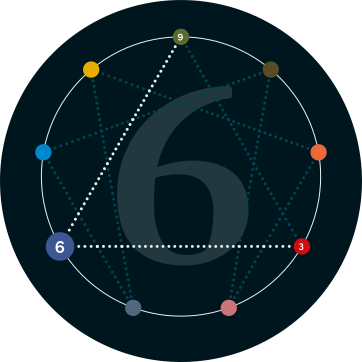
Under stress (moves toward Three): When overwhelmed, Sixes can shift into the territory of Type Three – becoming more driven, image-conscious, and focused on achievement as a way of outrunning anxiety. The usual questioning may give way to a push toward productivity and a cutting off from the feelings underneath.
In growth (moves toward Nine): When Sixes relax their grip on needing to figure everything out, they can access the calm and groundedness of Type Nine. They become more trusting, more accepting, more able to rest in the present without bracing for what might come next. Peace becomes something to inhabit, not something to earn through preparation.
The three subtypes
Self-preservation Six: Warmth
The Six pattern here focuses on building safety through personal connection – finding a person or small group who can be relied upon. There’s often a warm, affiliative quality: working to maintain the bonds that provide security. This subtype may appear less visibly anxious, channelling the underlying doubt into friendliness and alliance-building rather than overt questioning.
“I like to join groups and I like to give to my friends, and have fun together. It gives me a feeling of belonging, which makes me feel secure.”
Social Six: Duty
Here the Six pattern expresses through allegiance to systems, rules, or shared principles. There’s a sense that safety comes from knowing where you stand within a structure and upholding the standards that hold it together. The challenge is that this can tip into rigidity or a reluctance to question the very authorities they’ve invested in.
“My father brought us up to be leaders, and leaders have responsibilities. I studied hard, got good grades, didn’t cause trouble.”
One-to-one (Sexual) Six: Strength/Beauty
The Six pattern here tends to meet fear by moving toward it rather than away from it. There’s often a bold, confrontational quality – challenging what feels threatening rather than avoiding it. This subtype can look quite different from the cautious image of a Six, but the underlying pattern is the same: the need for certainty, tested through action rather than analysis.
“I used to think I was a Three, because if something needed to be done, I would just go out there and do it. People said I was courageous, but I didn’t see it that way.”
The path of integration
Integration for Sixes doesn’t mean eliminating their vigilance – it means holding it more lightly. With greater awareness, a Six can notice the impulse to question and scan without automatically following it. They can feel uncertain without needing to resolve the uncertainty before moving forward, and trust their own judgement alongside the doubts.
TNE describes the spiritual dimension of the Six as courage and faith – the capacity to meet fear with acceptance rather than aggression or avoidance, and to trust in a foundation of strength that holds even when circumstances feel shaky. This isn’t blind optimism; it’s a deeper kind of steadiness, grounded in the body as much as the mind.
The invitation for Sixes is to discover that they can handle whatever comes – that their own judgement is trustworthy, that certainty isn’t required for action, and that courage means moving forward with fear, not waiting for its absence.
Sixes in relationship
Sixes bring loyalty, commitment, and a genuine desire to build something that lasts. They take relationships seriously and tend to be deeply dependable – the kind of person who shows up when things get difficult, not just when they’re easy.
The challenge is that the pattern of questioning and testing can make partners feel evaluated or never quite believed. Sixes often feel trust deeply but find it easier to voice the doubt. Practising naming what feels solid – out loud – can make a real difference.
It helps to understand that the questioning a Six directs outward is usually a fraction of what they direct at themselves. The need for certainty applies to everything, but it falls hardest on their own decisions and their own worth.
Understanding Sixes
Whether you’re a Six recognising yourself, or someone trying to understand a Six in your life, these are worth keeping in mind:
- Take their fears seriously before helping them to scrutinise them – dismissing a Six’s concern only increases it
- Be consistent and trustworthy in your own actions – Sixes are watching for congruence between what you say and what you do
- Tell them what you are thinking and how you feel – ambiguity is more threatening than difficult truths
- Remind them of pleasant alternatives to offset the negative ones – help them trust the future, not just prepare for it
- Encourage them to initiate positive action – Sixes can get stuck in thinking and planning without moving
This page is an introduction to the Six pattern. The Enneagram is best understood through conversation and lived experience – hearing how others of the same type describe their inner world. Our courses and events explore all nine types this way, in small groups.
Go deeper with your type
These pages are a starting point. To really work with your type, it helps to hear from others and explore the patterns in conversation. That’s what our courses and events are for.
See what’s coming up