 Enneagram Café
The Performer
Type Three
Threes tend to see the world as a place that rewards people for what they accomplish rather than who they are. They often find belonging and self-worth through achieving goals, looking capable, and gaining the recognition of others.
 It wasn’t until my sports teacher pointed it out that I realised my winning meant someone else losing. I really had no idea that me feeling great meant someone else feeling lousy. Inside I was competing with myself.
Emotions interfere with getting the job done, and there is always a job to be done.
There’s an incongruity between the way you feel about something and the way you appear or behave around it. You smile and say ‘Thanks,’ but inside it’s ‘But it’s not me they’re praising.’
Is this a real feeling, or is it just another part of my image?
What they need
To be successful, admired, and valued
What they avoid
Failing, being exposed as incompetent, or feeling worthless
- A natural ability to set goals and follow through with energy and focus
- Adaptable – able to read a room and adjust to what’s needed
- Enthusiastic and encouraging, often lifting others along with them
- Efficient and practical – they find a way to make things happen
- A capacity to inspire confidence and motivate people toward a shared aim
- Can lose touch with their own feelings in the push to keep achieving
- Image management that becomes so automatic they may not notice it
- Difficulty slowing down – rest can feel like falling behind
- A tendency to measure their own worth by external results
- Vulnerability and authenticity can feel risky, especially when success depends on appearing capable
Recognise yourself? Our free exploration can help you find out whether this is your type – in your own words, at your own pace.
Begin the explorationThe inner world of a Three
For Threes, there’s a deeply held sense that the world values people for what they do – for their achievements, their competence, their results. Early on, many Threes picked up the message that love and approval came through performance: being the best student, the most capable employee, the person who gets things done. Over time, this creates a strong orientation toward goals, efficiency, and recognition.
This often shows up as a kind of internal gear-shifting – a quick, often unconscious reading of what success looks like in any given context, followed by an adjustment to meet it. Threes can be genuinely skilled at adapting, and the results are often impressive. But underneath the accomplishments, there can be a quieter question: who am I when I’m not performing?
The challenge is that the doing can become a substitute for being. When attention is habitually focused on the next goal, the next achievement, the next impression to manage, it becomes harder to pause and notice what they actually feel – or what they genuinely want, apart from what others might value. With awareness, Threes can begin to separate who they are from what they produce.
The Three pattern in everyday life
Many Threes describe a kind of automatic forward motion – a background sense that there’s always something to accomplish, optimise, or move toward. This can make them impressively productive, energising to be around, and genuinely good at getting things done. It can also make it hard to be still, to feel without acting, or to let themselves be seen without a polished surface.
At their best, Threes bring a rare combination of energy and adaptability. They inspire others, follow through on what they commit to, and often make difficult things look easy. When the pattern runs them rather than the other way around, the same qualities can tip into overwork, image management, and a sense of hollowness beneath the achievements.
The key insight for Threes is that the pattern itself isn’t the problem – it’s when it operates on autopilot. Noticing the impulse to perform without automatically acting on it creates space for choice: to pursue what genuinely matters, and to let themselves be valued for who they are rather than what they deliver.
How Threes pay attention
For Threes, attention tends to be pulled toward goals, tasks, and what success looks like in the current context. Walk into a meeting with a Three and they’re often reading the room – tracking who matters, what’s valued, how to position themselves and their ideas effectively. This isn’t calculated scheming; it’s an automatic pattern of attention, scanning for the path to recognition and approval.
At work, a Three isn’t just completing a task – they’re often simultaneously managing how the work is perceived, adjusting their presentation for the audience, and lining up the next objective. In social settings, they may find themselves adapting their energy, tone, and even interests to match what feels valued by the people around them.
This pattern of attention makes Threes naturally skilled at goal-setting, reading contexts, and getting results. But it can also mean that their own feelings – what they genuinely want, what they actually feel in the moment – get less airtime. Becoming aware of where attention goes is often the first step toward making space for what’s underneath the performance.
Separation distress and bonding
Threes are a Heart Centre type, which means they tend to process the world through feelings and relational awareness. You might expect Heart Centre types to have easy access to emotion, but for Threes it’s more complicated. When being successful matters this much, feelings can feel like obstacles – things that slow you down or get in the way of the work.
So the feelings tend to get set aside. A Three might close a significant deal and immediately turn to the next goal, never pausing to feel the satisfaction. They may carry a quiet sadness – a sense of distance from their own emotional life – without fully recognising it. The drive to perform is partly fuelled by this: a deep, often unconscious concern that without their achievements, they might not be valued or loved.
One of the most useful things a Three can learn is that feelings aren’t a distraction from real life – they’re part of it. With practice, pausing to notice what’s actually happening inside becomes less like an interruption and more like coming home.
Not sure if this is your type?
Our free typing exploration uses open-ended questions to help you find the types worth investigating. No algorithms, no scores.
Find your typeStress and growth
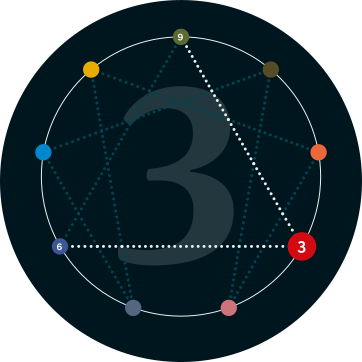
Under stress (moves toward Nine): When overwhelmed, Threes can shift into the territory of Type Nine – becoming disengaged, scattered, and avoidant. The usual drive and focus may give way to numbing out, losing themselves in distractions, and struggling to take action on what matters.
In growth (moves toward Six): When Threes relax their grip on image and achievement, they can access the loyalty and depth of Type Six. They become more collaborative, more willing to show vulnerability, and more able to commit to others without needing to perform. Connection becomes something to experience, not something to earn.
The three subtypes
Self-preservation Three: Security
The Three pattern here focuses on working hard for material stability and practical results. There’s often a quieter, less flashy quality than other Threes – more emphasis on solid achievement than public recognition. This subtype can look more like a One, but the underlying drive is about earning value through competence rather than meeting an internal standard of correctness.
“I come from a poor background. It has been a lifelong determination that I would never be in those financial straits.”
Social Three: Prestige
Here the Three pattern expresses through status, visibility, and being seen as successful in the wider social world. The Three pattern here tends toward credentials, titles, and markers of achievement that others recognise. The challenge is that the image can become so polished that it feels difficult to let anyone see what’s behind it.
“I’m head of, or on the committee of, most of the good local organisations and social clubs.”
One-to-one (Sexual) Three: Charisma
In close relationships, the Three pattern can focus its performing energy on being attractive, desirable, and valuable to specific individuals. There’s often a warmth and personal magnetism here, along with a tendency to support a partner’s success as a way of maintaining their own sense of worth in the relationship.
“It’s always been important to me that I look good, that people look at me and are attracted.”
The path of integration
Integration for Threes doesn’t mean abandoning their drive – it means discovering who they are apart from their achievements. With greater awareness, a Three can notice the impulse to perform without automatically acting on it. They can pursue goals without their identity depending on the outcome, and they can let themselves be seen without a carefully managed surface.
TNE describes the spiritual dimension of the Three as authenticity – the capacity to tell the truth about who you are, regardless of the consequences. This isn’t about rejecting achievement; it’s about letting the doing flow from genuine desire rather than from a need to prove their worth.
The invitation for Threes is to discover that they are already valuable – that their worth doesn’t depend on what they produce, that slowing down isn’t failure, and that the people who matter most want to know who they really are, not just what they can do.
Threes in relationship
Threes bring energy, competence, and a genuine desire to build something good together. They tend to be supportive partners who follow through on commitments and work hard to create a life that feels successful and shared.
The challenge is that the pattern of performing can make partners feel like an audience rather than a companion. Threes often care deeply but find it easier to show love through doing – achieving, providing, making things happen – than through simply being present. Practising being together without an agenda can make a real difference.
It helps to understand that the image a Three presents is often less about deception and more about a deep, sometimes unconscious fear of being rejected for who they really are. Valuing them for who they are – not just what they accomplish – is one of the most important things a partner can offer.
Understanding Threes
Whether you’re a Three recognising yourself, or someone trying to understand a Three in your life, these are worth keeping in mind:
- Let them know you care for who they are aside from their accomplishments, and that it’s OK to feel vulnerable
- Remember they look confident but often they’re not – the surface can be very different from what’s underneath
- Don’t criticise or attack – it increases low self-esteem and reinforces the cycle of performing to earn worth
- Don’t reinforce achievement alone by praising results – appreciate them for being, not doing
- Remember that emotions can be frightening for Threes, and don’t take it personally if they seem to back away when they start to feel
This page is an introduction to the Three pattern. The Enneagram is best understood through conversation and lived experience – hearing how others of the same type describe their inner world. Our courses and events explore all nine types this way, in small groups.
Go deeper with your type
These pages are a starting point. To really work with your type, it helps to hear from others and explore the patterns in conversation. That’s what our courses and events are for.
See what’s coming up