 Enneagram Café
The Giver
Type Two
Twos tend to see the world through the lens of relationship – who needs what, who’s struggling, where connection is missing. Their attention naturally flows outward toward others, often at the expense of tracking their own needs and feelings.
 Even if I am alone, which is not often, I’m thinking of other people and how what I’m doing links me to them.
I tried to look inside for what I felt, and it was terrifying. There was just nothing – there didn’t seem to be anybody there at all, just a big empty hole.
I only get a sense of self by other people’s gaze on me. When I get attention, I can start to define who I am.
I rarely meet anyone I don’t like – I reframe the ones I don’t into a way that I can forgive them.
What they need
To be loved, appreciated, and connected
What they avoid
Being unwanted, unneeded, or overlooked
- Genuine warmth and emotional generosity – people feel seen around them
- An instinctive ability to sense what others need, often before it’s spoken
- Deep commitment to relationships and a willingness to show up for people
- A talent for creating connection and making others feel welcome
- Emotional courage – willing to move toward people rather than away
- Difficulty recognising or voicing their own needs – attention stays on others
- Giving that can carry unspoken expectations, leading to quiet resentment
- A tendency to shape themselves around what others want or need
- Self-worth that becomes tied to being helpful or indispensable
- Exhaustion from over-extending – without always noticing it’s happening
Recognise yourself? Our free exploration can help you find out whether this is your type – in your own words, at your own pace.
Begin the explorationThe inner world of a Two
For Twos, connection is at the centre of how the world makes sense. There’s a deeply felt awareness that relationships are what matter most – and a natural pull toward making sure others are supported, cared for, and happy. This isn’t performed generosity; for most Twos, the impulse to help feels as natural as breathing.
Underneath this outward orientation, though, there’s often a quieter question running: Am I loved for who I am, or for what I give? Many Twos developed an early sense that love was something earned through attentiveness and usefulness – that being needed was the surest path to belonging. Over time, this can create a habit of putting others first that feels generous but also quietly costly.
The challenge for Twos is that this pattern can become so automatic that their own needs become hard to access. When attention has been directed outward for long enough, the inward channel can feel unfamiliar or even uncomfortable. With awareness, Twos can learn to include themselves in the care they so readily offer others – to notice the pattern without being governed by it.
The Two pattern in everyday life
In daily life, the Two pattern often shows up as a background awareness of other people’s emotional states. Twos tend to track how those around them are doing – who seems upset, who needs encouragement, who’s been left out. This makes them deeply attuned companions, colleagues, and friends. It can also mean they carry a great deal of emotional information that isn’t theirs.
At their best, Twos bring a rare warmth and emotional intelligence to everything they’re part of. They make people feel genuinely seen and supported, and they often hold groups and relationships together in ways that go unnoticed. When the pattern runs them rather than the other way around, the same qualities can tip into over-giving, people-pleasing, and a growing frustration that the care isn’t being returned.
The key insight for Twos is that the pattern itself isn’t the problem – it’s when it operates without awareness. Learning to pause before helping, to ask “What do I actually need right now?” and to let others take care of themselves sometimes – these are small shifts that can make a significant difference.
How Twos pay attention
For Twos, attention tends to be pulled toward other people – their feelings, their needs, their unspoken struggles. Walk into a room with a Two and they may well have noticed who looks uncomfortable, who’s been left out of the conversation, who’s carrying something they haven’t said. This isn’t deliberate people-reading; it’s an automatic pattern of attention, scanning the relational landscape.
At work, a Two in a meeting isn’t just following the agenda – they’re often tracking the emotional undercurrents. Who seems frustrated? Who needs encouragement? Who’s struggling with something that hasn’t been named? They tend to file this information and act on it later – a quiet check-in, an offer of help, a word of support.
The blind spot is themselves. When asked “What do you need?” many Twos find the question surprisingly difficult. Their attention has been so consistently outward that turning it inward can feel unfamiliar, even unsettling. Becoming aware of this pattern – noticing where attention goes automatically and what gets missed – is often the beginning of a meaningful shift.
Separation distress and bonding
Twos are a Heart Centre type, which means they tend to process the world through feelings and relational awareness. For Heart Centre types, there’s a particular sensitivity around connection and belonging – a felt sense that relationships are where identity and worth are established.
For Twos, this shows up as a deep pull toward bonding and a corresponding distress when connection feels at risk. The Two strategy is to become indispensable – to be so attuned and so helpful that the relationship feels secure. When approval or appreciation isn’t forthcoming, it can trigger a sense of unworthiness that feels out of proportion to the situation.
Understanding this pattern can be genuinely freeing. The distress Twos feel when they sense distance in a relationship isn’t a personal failing – it’s the Heart Centre doing what it does. With awareness, Twos can learn to notice the pull toward giving-to-connect without automatically acting on it, and to trust that they belong even when they’re not actively earning it.
Not sure if this is your type?
Our free typing exploration uses open-ended questions to help you find the types worth investigating. No algorithms, no scores.
Find your typeStress and growth
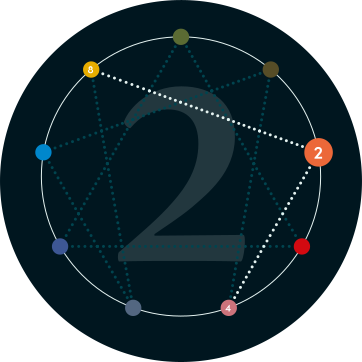
Under stress (moves toward Eight): When overwhelmed, Twos can shift into the territory of Type Eight – becoming more forceful, demanding, and direct about what they feel they’re owed. The usual warmth may give way to confrontation, and suppressed resentment can surface as anger or attempts to control. It can surprise both the Two and those around them.
In growth (moves toward Four): When Twos turn attention inward, they can access the emotional depth and self-awareness of Type Four. They become more honest about their own feelings, more willing to sit with difficult emotions rather than redirecting into helping. Giving becomes freer – less tied to being needed, more genuinely offered.
The three subtypes
Self-preservation Two: Privilege
The Two pattern here focuses on securing comfort, safety, and care – often through charm and likability rather than overt giving. This subtype can look less like a typical Two, sometimes appearing more playful or even childlike. The underlying pattern is still relational, but there’s a greater awareness of personal needs alongside the attentiveness to others.
“If I waited and didn’t take care of it, there wouldn’t be enough for me. But I won’t ask my family for help – I’d feel guilty, and a failure.”
Social Two: Ambition
The Two pattern here expresses through connection with groups, communities, and people of influence. There’s often a talent for reading social dynamics and positioning themselves where their relational skills are most valued. The challenge is that the desire to be important to others can shade into strategic helpfulness – giving with an eye on standing.
“I decided early on that I was going to marry a high society Anglican priest. I wouldn’t even go out with someone who wasn’t applying for, or at the best College.”
One-to-one (Sexual) Two: Seduction
The Two pattern here concentrates its energy on specific individuals – a desire to be uniquely important to someone. There’s often an intensity and emotional focus that creates deep bonds. The challenge is that the pull toward closeness can become possessive, and the need to be chosen above others can create pressure in intimate relationships.
The path of integration
Integration for Twos doesn’t mean caring less about others – it means learning to include themselves in the circle of care. The integrated Two can give freely without keeping a quiet tally, and receive without feeling guilty or needing to immediately reciprocate. The generosity becomes more genuine because it’s no longer carrying the weight of unmet needs.
TNE describes the spiritual dimension of the Two as humility – the capacity to recognise one’s own needs and accept help from others, without seeing this as weakness. This isn’t self-denial; it’s a more honest kind of engagement, where giving and receiving flow both ways.
The invitation for Twos is to discover that they are lovable for who they are, not for what they provide – that having needs doesn’t make them needy, and that true connection requires both offering care and allowing it in.
Twos in relationship
Twos bring warmth, attentiveness, and a genuine desire to make the people they love feel cared for. They tend to remember what matters to their partners, anticipate needs before they’re spoken, and work hard at creating emotional closeness.
The challenge is that partners may not know what the Two actually wants – because the Two may not tell them, or may not know themselves. Over time, the imbalance between giving and receiving can build quiet resentment. Twos often need explicit encouragement to voice their own needs, and partners who make space for this rather than simply accepting the care on offer.
It helps to understand that a Two’s giving isn’t usually strategic – the warmth is real. What gets complicated is the unspoken expectation that can attach itself to generosity. Naming this openly, with kindness, tends to strengthen the relationship rather than threaten it.
Understanding Twos
Whether you’re a Two recognising yourself, or someone trying to understand a Two in your life, these are worth keeping in mind:
- Let them know you like them for themselves, the whole person – not for what they do or give
- Don’t ask what they need – they probably won’t know. Instead, just do something for them
- Mirror them back to themselves: “This is what I see in you, it’s constant, it doesn’t change, it’s good”
- When they are down on themselves, point out how much they do to themselves that’s unkind – they may not see it
- Be sincere and speak from your own emotions – Twos can sense inauthenticity immediately
This page is an introduction to the Two pattern. The Enneagram is best understood through conversation and lived experience – hearing how others of the same type describe their inner world. Our courses and events explore all nine types this way, in small groups.
Go deeper with your type
These pages are a starting point. To really work with your type, it helps to hear from others and explore the patterns in conversation. That’s what our courses and events are for.
See what’s coming up